
A rambling tale of a tall flower
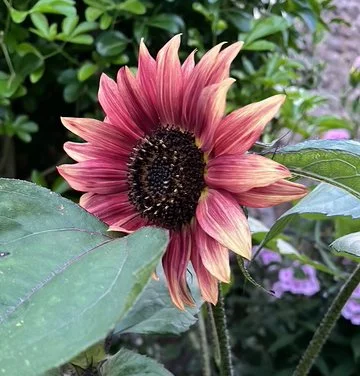
At first glance, the Sunflower’s tale is a sad romance. Our media constantly references romantic love, and the Sunflower’s is unrequited... but are we missing the point?
Here is the story… Far back in the days when the Gods ruled from Mt Olympus, Clytie the water nymph fell in love with Helios, the great god of the sun, who rides his fiery chariot across the sky to this day. He left her for a mortal princess and, in despair, Clytie refused to eat and drink and lay on the rocks gazing at Helios’ progress for nine days. As her body withered, she took root, eventually metamorphosing into the sunflower, whose young flowers track from East to West, charting the fiery chariot of the sun. And so it is to this day: and when the flower became mature, she settles into looking East, to greet Helios every dawn.
For a fuller retelling with eye-candy illustrations, click here. The film draws its own conclusions – see if you agree with them
You can find the lessons I extracted from this story in my mailshot. But I’d like to expand on one of these.
I dispute the tragic nature of the story. Is metamorphosis, after prolonged focus on something, such a bad thing?
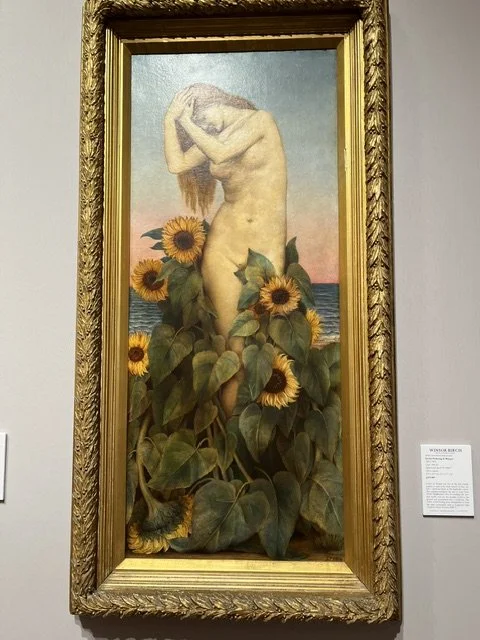
Clytie with sunflowers 1885 Evelyn de Morgan
Perhaps, through devotion and single-mindedness, a person – a nymph, or maybe ourselves? - might contact an aspect of something essential for our spiritual needs, and adapt to this deep urging. Would you rather be an unhappy nymph, or a happy sunflower?
One of the lessons we gain from the vegetable kingdom is that plants are not judgemental; they fulfil their deepest nature during their incarnation, then seed to perpetuate themselves before they wither. That feels like a good life.
Unlike Daphne or Pitys – also Greek nymphs who metamorphosed into the laurel and the pine respectively - we cannot literally become other than what we are, but we can notice and emulate their qualities of other sentient life forms. The witness and patience of the trees: the generosity of fruit and seeds from the shrubs: the imperative urge to spring and thrive from common wildflowers and weeds. The tendency nowadays is to take myths too literally and ignore the subtler interpretation that may reveal more profound truths. If we do not get sidetracked by the romance aspect, the lessons of Clytie can inform us in a more meaningful way.

Shaggy sunflower-head Bowie - adolescent crush extraordinaire!
Think back to your adolescence. Chances are you had at least a mild fixation on someone famous – even before the advent of celebrity culture. When we were relatively powerless in youth, waiting impatiently for the world to open up, our role models appeared to have it all. Their posters were on the wall and we went to sleep dreaming of them. And there were stories to encourage our adoration… Bob Dylan spotted Scarlet Rivera with her violin in the street, picked her up and took her to the recording studio: an adolescent dream fulfilled which would surely justify our own longings? The fact that we could no more play the fiddle than fly was neither here nor there - teenagers just focus on others whose very existence takes them imaginatively beyond the limitations of the known and hints at something wider. I’m sure Clytie, ill-prepared water nymph, half-thought that wishing hard enough would get her a ride in the Sun God’s airy chariot at the very least.
So what might be the main lesson of the story of Clytie?
Although her obsession remains unfulfilled she still transforms.
There is are two lessons for all of us here.
It is right that we should have role models that inspire us
It’s important not to stick at the level of fixating upon a person. That is how trolls and stalkers are born.
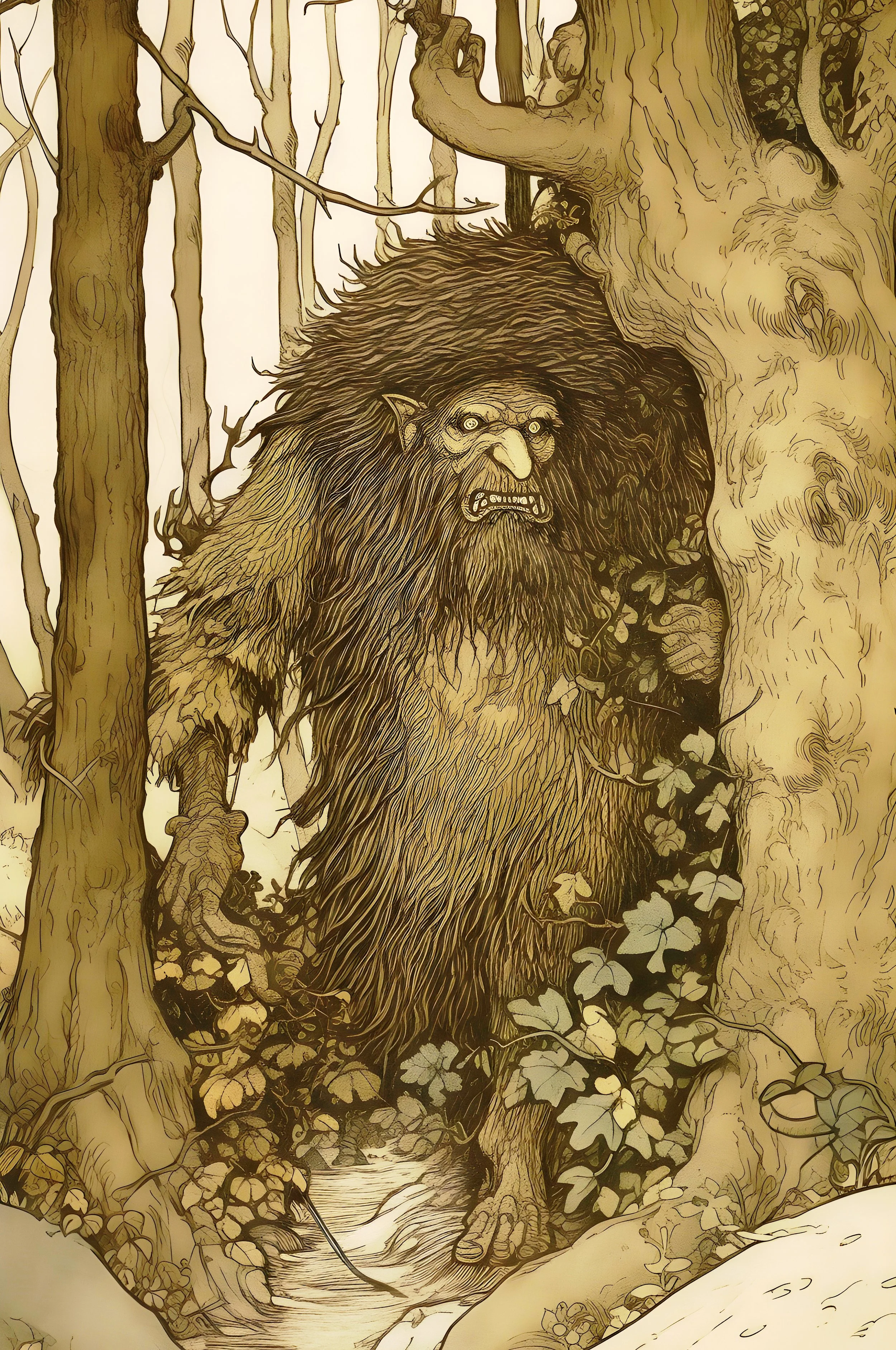
Benign admirer or something more lurk-y??? Beware!!!
A helpful attitude towards these instincts is to become fascinated by why those people are so attractive to us. What is it about them?
In adolescence we fathom relationships crudely: mistaking jealousy for love, wayward/illegal behaviour for a free spiritedness that we would not dare follow. Now think about a role model who still inspires you in your mature years. If they are still alive, they will not have the same physical attraction they had all those years ago.
But there is still something.
It’s the wow factor: charisma.
They seem to inhabit a more-than-mortal status, just like the charisma around Helios the Sun God.
What on earth is it? It’s possibly that our hero/ines seem to have worked out something about their place in the world.
How relaxing to be around people who have their attitude to life sorted! We feel the gravitas that comes of being at home in their body and their world. They have confidence in their path. Often, they have focused on expressing themselves creatively and making other aspects of life subservient to that focus.
Disclaimer: other role-model qualities are as relevant, just not our subject today. So if your hero is flawed or damaged, see the footnote for more information.
A Druidic stance is first and foremost to be at home; in your body, your home, your society, your world. Secondly it is to be a witness, for, ‘The world desires to be appreciated by us.’ Well, Clytie certainly was that admiring witness, and is to this day, as my sunflowers prove. And thirdly, Druids feel they are here to be creative – not necessarily be in areas regarded as ‘bardic’. Gardening, walking in nature, cake making – it’s our job to discover what expands our spirit.
Without creativity, we are just going through the motions of life: with creativity, we are truly living.
So, how to harmonise our imaginative but internalised hero worship of a famous person and the instinct to action, to use our own natural capabilities creatively?
Consider your role models
Look not at, but into the person to identify the qualities in them that you admire and might lack. Consider this deeper aspect as your eyes follow their journey across TV, media outlets, magazine shoots, live concerts or art exhibitions, performances and dance?
Isolate these qualities that our heroes have in superabundance
How can you nurture them in yourself? Be gentle but be consistent: be constant in your approach
Can our heroes point the way to what we lack? Look back at the legend.
Clytie is seen as a constant nymph, but it is actually Helios the Sun who is constant.
He cannot take a day off to go a-mollocking round with a water nymph who is so very needy! His course in life is set, and his passage across the skies gives life to all of the Earth. Constancy is his fundamental quality.
When Clytie witnesses and engages, not with the person, or the God, but with that quality to become constant, consistent in her approach, she becomes true to her deepest self.
Constancy is what she was lacking, and when she demonstrates it with her devotion, the Earth responds to nurture her; her roots grow and she is transformed.
To repeat; would you rather be an unhappy nymph or a beautiful sunflower? In the place always intended for you? Sunkissed all your days? And with the beauty of your flowers giving way to seeds that grow or nourish other lives..? You decide.
There is a bonus gift to this approach. When open ourselves to the qualities we lack without fixing them to set expectations or outcomes, we let in the magical and unexpected.
Example: I identify a lack of beauty in my life.
To experience beauty, I can’t wait for my sunflowers to open and become obsessed with their progress. This is the beauty I crave.
After days of not noticing anything else, suddenly the scent of honeysuckle overwhelms me. There it is, spilling over my garden wall.
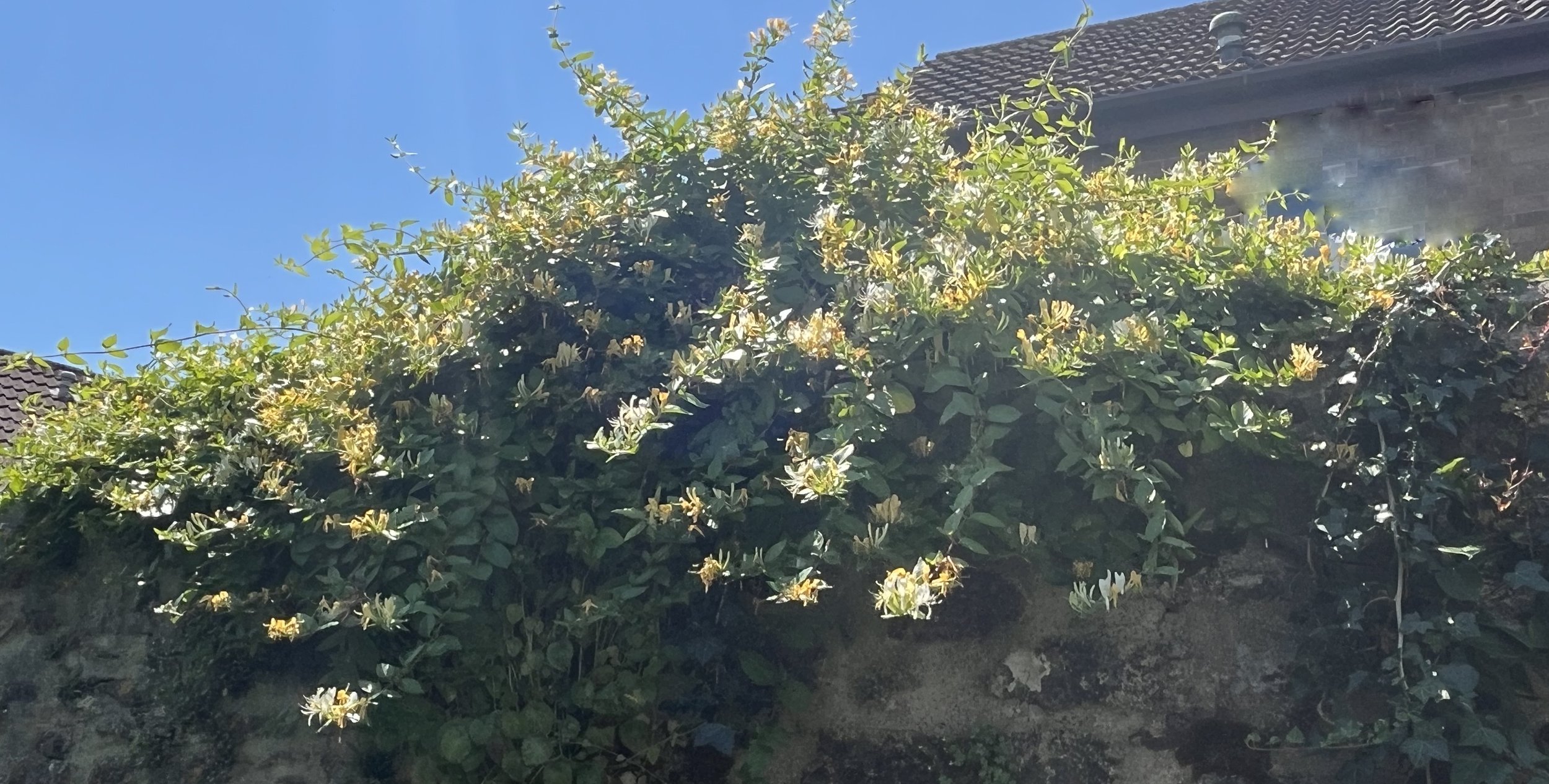
Dawn-lit crown of honeysuckle. Just one expression of the beauty of summer.
I didn’t grow it: like Taliesin or Finn who received magical gifts, I didn’t do anything to deserve it but it is just there, from a neighbour’s garden. It is a gift of grace, perfuming every evening, a diadem crowning the old grey stones. It holds the same quality of beauty as the sunflower, the quality I’ve asked for, just differently expressed. And if it wasn’t for its intoxicating scent, I might have missed it!
I hope that Clytie, during those long hot days, also noticed: smelt the scent of the pines, heard Minerva’s owl hooting the wisdom of her course through the cool, starlit nights.
Well, there it is: a few hot summer thoughts whilst the Sun is burning so strongly that I cannot go out without immediate exhaustion. But my sunflowers are thriving. They face East in the morning, and by nightfall, they have turned their faces to the west.
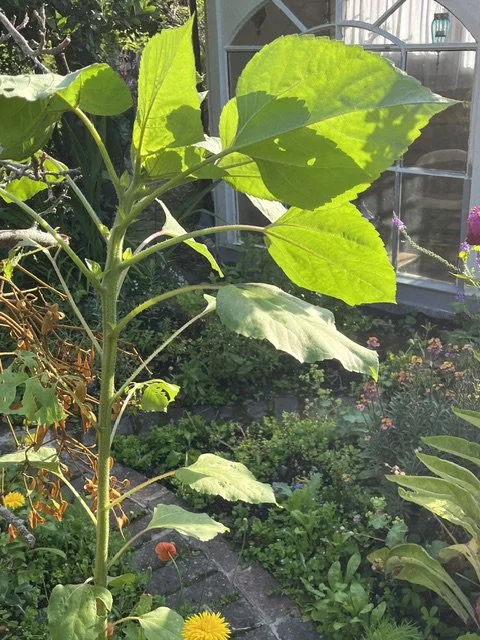
Faithfully facing East: 6am
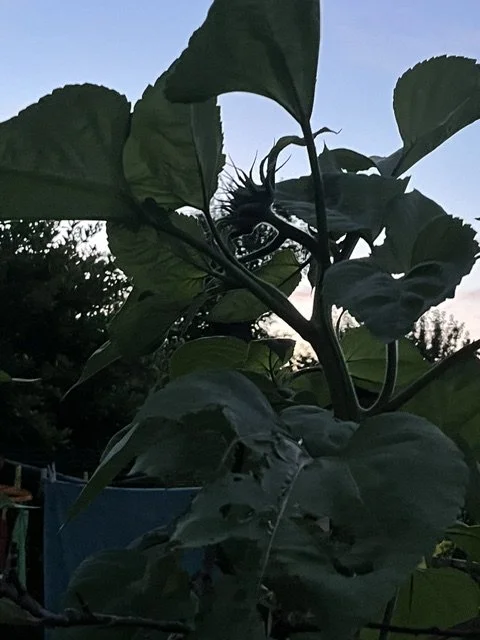
...and West, 10pm. The Sunflower’s daily track
They remind me to witness the constant sun and the ever -changing moon and balance those qualities in myself, against the background of the far-reaching stars and harmony of the cosmos. For who would witness the world if not us? And how else would we find our proper place in it?
With thanks to David Bowie, Bob Dylan, Leonard Cohen and all those ol’ geezers who inspired and shaped my young ideas so long ago.
Happy high summer to all, Penny /|\
Footnote: The adjunct to wise role models is our need for the magic of the ‘wounded creative’ who suffers and is often a sacrifice to modern culture. See Ghosts of the Medicine Show: An Odyssey into the Shamanic Roots of Popular Entertainmentby David Bramwell.